
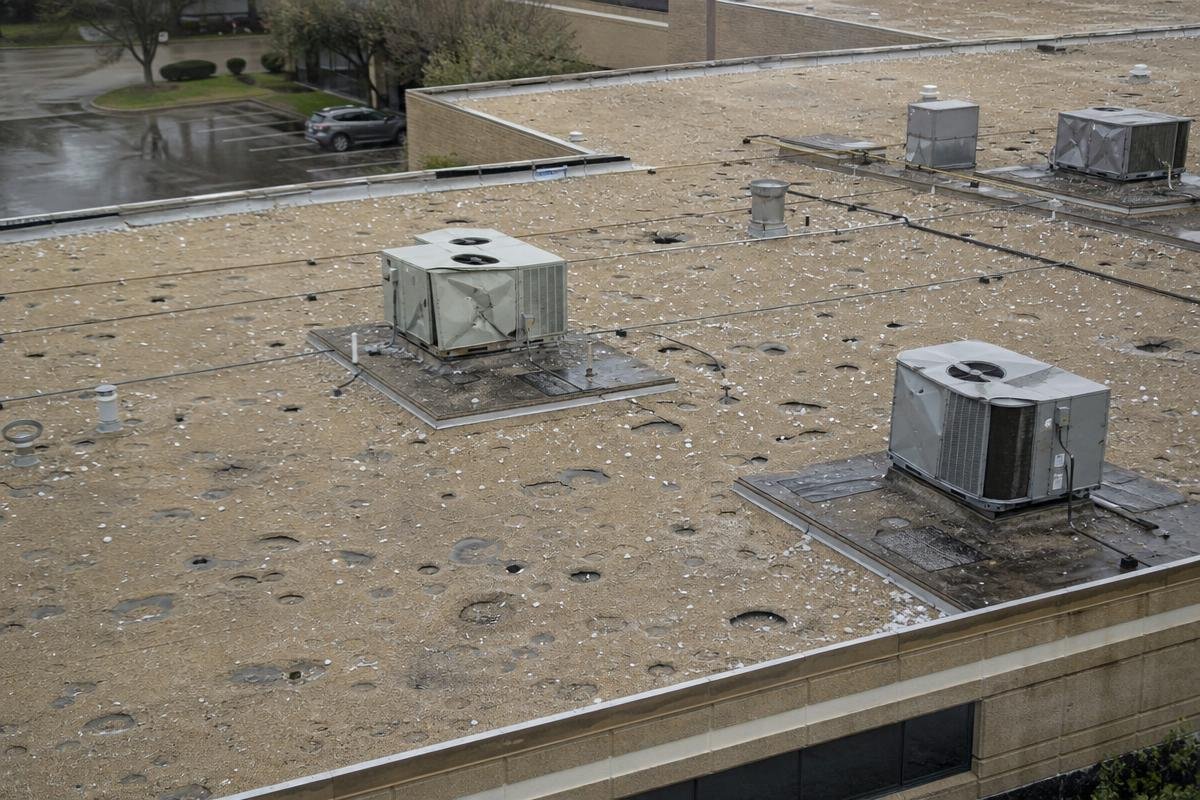
A DFW hailstorm rolls through Lewisville, drops golf-ball-sized hail on your building’s roof and parking lot, and is gone in 20 minutes. The sky clears. Your business opens the next morning. Everything looks fine. It isn’t. Commercial storm damage in this part of the Metroplex is rarely obvious from the ground, and the red flags that lead to a six-figure repair bill are almost always the ones owners miss in the first two days. We have been working commercial and residential properties across Denton County since 2009, and we respond around the clock because storms don’t wait for business hours.
Hail hit your building? Get eyes on it before your insurance window closes.
Key Takeaways
- Commercial storm damage is often invisible from the ground, especially on flat and low-slope roofs common across Lewisville’s office and retail corridors.
- Missing damage in the first 48 to 72 hours can void portions of your commercial insurance claim before it’s even filed.
- Hail as small as one inch can fracture roofing membranes, damage HVAC units, and compromise skylights without leaving obvious exterior signs.
- Buildings constructed in the 1980s and 1990s face higher risk because many roofs are at or past their original design life.
- An IICRC-certified team should inspect your property after any severe storm, even if the building looks undamaged from the parking lot.
Commercial buildings along the I-35E spine and the Vista Ridge corridor absorb storm punishment differently than homes do. Flat and low-slope roofs, rooftop HVAC units, skylights, loading dock overhangs, and large parapet walls all take hits that stay completely invisible from the ground. The damage is real. You just can’t see it yet.
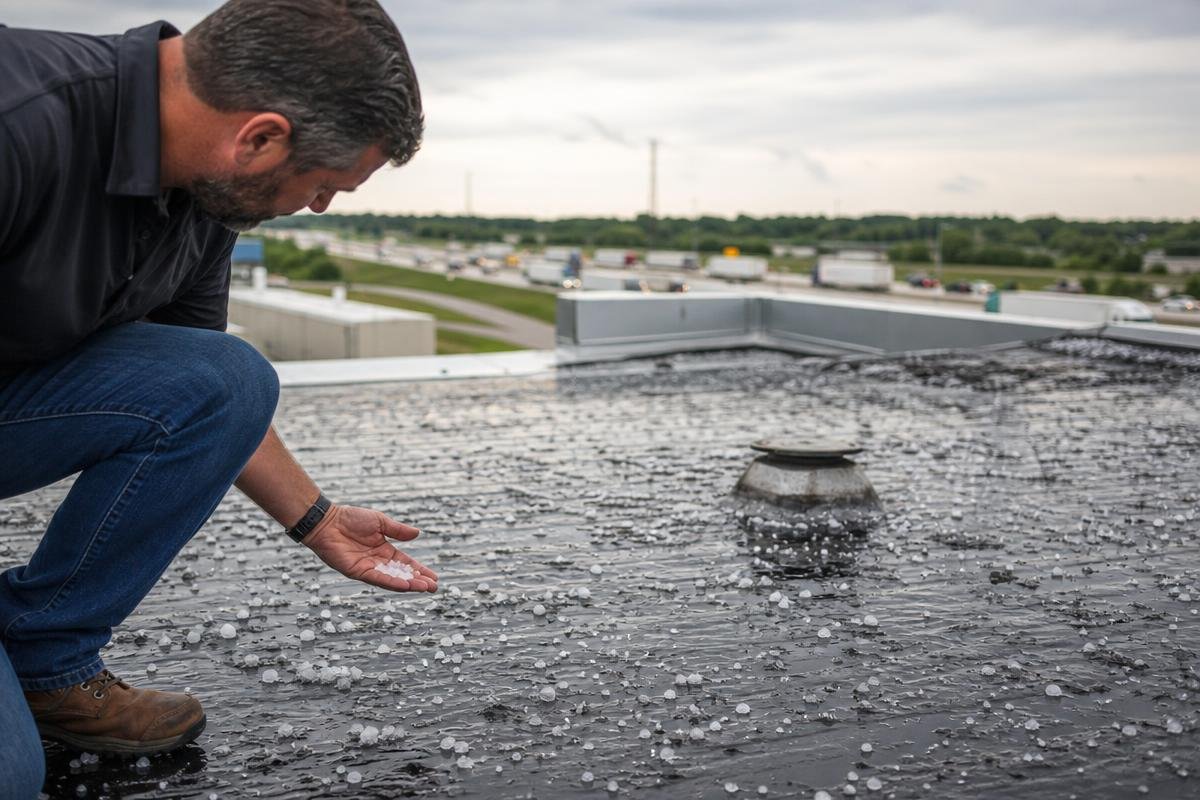
That gap between “looks fine” and “actually fine” is where the real money gets lost. Catching the right failure points in the first two days is the difference between a manageable insurance claim and a repair bill that climbs into the tens of thousands. Miss the window, and your carrier has a much easier argument that the damage was pre-existing or owner-neglected.
The Regent Restoration team has walked commercial rooftops across this region the morning after storms since 2009, and the same nine red flags come up again and again. Business owners and property managers miss them every time, not because they aren’t paying attention, but because these warning signs don’t look like damage. Below, we cover each one, what it means, and what to do about it. If you already know you need help, our team handles water damage restoration in Lewisville and storm recovery around the clock.
Why Commercial Buildings Take a Different Kind of Hit Than Homes
A hailstorm that leaves dents on your neighbor’s shingles can do something far more expensive to a commercial building down the street. The failure modes are completely different. And because most business owners and property managers judge roof damage from the parking lot, the worst damage often goes undetected for weeks.
Flat Roofs Don’t Shed Hail the Way Pitched Roofs Do
Pitched residential roofs let hail bounce off and roll away. Flat and low-slope commercial roofs, which dominate the Vista Ridge corridor and the warehouse and flex-space buildings along I-35E, take every impact directly. The two most common membrane materials, TPO (thermoplastic polyolefin) and EPDM (ethylene propylene diene monomer), develop micro-fractures on impact that are invisible from ground level. The roof looks fine from the parking lot. It is not fine.
Water enters those micro-fractures slowly. It saturates the insulation board underneath. In a 10,000-square-foot building, water entering at one rear penetration can travel 30 to 40 feet along the decking before it drops through a ceiling tile in a completely different room or tenant space. That’s why a ceiling stain in your front office may have nothing to do with the roof directly above it. A proper membrane assessment means walking the surface and checking every seam, drain, and roof penetration, not scanning from below.
In North Texas summer humidity, saturated insulation can support mold growth within the first two days. If that water goes undetected, you’re looking at a mold remediation situation on top of the original roof repair bill.
Rooftop Equipment Is a Primary Target
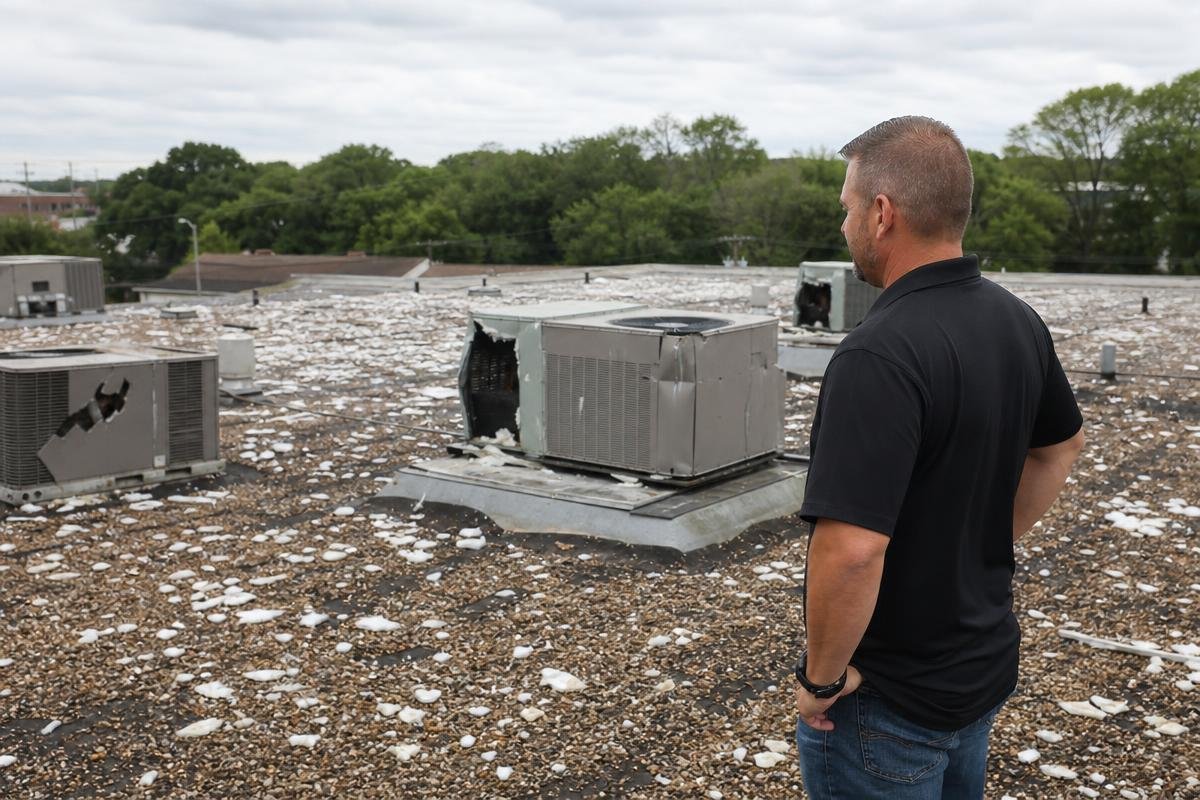
Your HVAC condensing units sit exposed on the roof. Hail bends the aluminum fins that control airflow, reducing efficiency immediately. Cracked refrigerant lines may not fail until the next heat cycle, weeks after the storm. Skylights and smoke vents crack at frame edges and gaskets, not through the center panel, so they pass a casual visual check but let water in during the next rain event.
Water Travels Far Before It Shows Up Inside
Many commercial buildings along the I-35E corridor were built in the 1980s and 1990s, putting their roofing systems at or past design life. Aging membranes give water more pathways. By the time a ceiling tile fails or a stain appears, the insulation and decking above it may already be saturated across a wide area. The visible damage is rarely the full picture.
What Are the Signs of Commercial Storm Damage After a Hailstorm?
The clearest signs are granule loss at your downspouts, bent HVAC fins, cracked skylight frames, blocked scuppers, sagging ceiling tiles, and staining along parapet walls. Walk your building within 24 hours of a DFW hailstorm. You don’t need to get on the roof for most of these checks. You need to know what to look for at ground level, inside the building, and along the roofline from a safe vantage point. Missing even one of these signs can turn a manageable claim into a repair scope that runs into six figures.
1. Granule Loss on Any Sloped Roof Sections
Check your gutters and downspout splash blocks first. Granules look like coarse sand or gravel. After a hailstorm, a heavy deposit of granules at the base of your downspouts means the asphalt mat underneath is now exposed. That mat degrades fast under direct Texas sun. Document it with photos before anything gets swept away.
2. Bent HVAC Fins
Walk to your rooftop HVAC units or check ground-level condensers. Fins bent more than 30 percent of their surface area indicate hail large enough and fast enough to matter to your insurance adjuster. Adjusters photograph fin damage specifically as proof of event severity. Don’t straighten them before your adjuster visits.
3. Cracked Skylights and Popped Smoke Vents
Cracks usually appear at the gasket and frame edges, not through the center panel. Check smoke vent hinges for any gap where the lid no longer seats flush. A popped hinge lets water in during the next rain. If you have skylights on older flex-space buildings along the I-35E corridor, check every one.
4. Dented or Detached Gutters and Scuppers
Flat commercial roofs drain through scuppers, which are openings in the parapet wall. Hail can dent and partially block them. A blocked scupper means standing water on your roof after the next storm. That standing water is the beginning of a much larger problem. Check that water flows freely through every opening.
Not sure if your roof took a hit? We’ll walk it for you. Free inspection for commercial properties in the Lewisville area.
5. Sagging or Discolored Ceiling Tiles
A single sagging tile is not a cosmetic issue. It means water has already saturated the insulation above and is pooling on the tile surface. Learn more about what ceiling water stains actually signal about the damage above them. Ignore it and mold can establish before your next rain event.
6. Water Stains Along Parapet Walls
Parapet wall flashing failure is one of the most overlooked failure points in a storm damage assessment on commercial property. Look for staining on interior walls near the roofline. If the flashing lifted or separated during the storm, water is already working its way into the wall assembly.
7. Fogged or Milky Storefront Glazing
Fogged double-pane glass means the seal is broken and moisture is entering the wall cavity. This is especially common in older retail strips built in the 1980s and 1990s around the Old Town district. Once the seal fails, the insulating gas escapes and your energy costs climb while the wall cavity stays wet.
8. Lifted Metal Flashing on Canopies and Awnings
Check the leading edge of every canopy and awning for flashing that has lifted, bent back, or separated from the fascia. Even a small gap funnels water directly into the wall behind it. This is a fast fix if caught early. Left alone, it means roof repair work that goes well beyond the flashing itself.
9. Soft or Spongy Feel on the Flat Roof Membrane
This one requires a qualified contractor on the roof. Press down near drains and penetrations. A soft or spongy feel means the insulation below the membrane is already saturated. Saturated insulation typically requires full replacement, not just a membrane patch. On the flat-roof buildings that dominate the I-35E commercial spine, this is the most expensive finding you can make after a hailstorm.
The Damage You Don’t See Right Away Is Usually the Damage That Costs the Most
A hailstorm rolls through on a Thursday afternoon. By Friday morning, your building looks fine from the parking lot. No broken windows. No obvious leaks. You figure you got lucky. That assumption is exactly how a manageable storm damage assessment on a commercial property turns into a five-figure remediation job three weeks later.
Mold Starts Before the Ceiling Tile Sags
Most commercial buildings in the 75057 and 75067 ZIP codes use fiberglass batt insulation above drop ceilings. That material holds water like a sponge. After a hailstorm punches small penetrations in a membrane roof, water soaks into that insulation and sits there, invisible from below.
In late-spring and summer conditions, mold colonies can establish in saturated insulation before your next rain event. By the time a ceiling tile visibly sags or stains, the scope of mold remediation has already grown well beyond what a surface inspection would catch. That is real money. Remediation that might have cost a few thousand dollars on day two can multiply significantly by day fourteen.
Structural Deck Damage Doesn’t Show Up in a Walk-Through
Steel roof decks lose load-bearing capacity at hail-impact dent points. Wood decks begin to delaminate when wet. Neither failure is visible from inside the building. You can walk every inch of your warehouse or office space and see nothing wrong.
Large hail, 1.5 inches or greater, is common on supercell tracks moving northeast through this corridor. That size causes structural deck damage that only becomes apparent when a contractor probes the deck from above with insulation pulled back. We have been doing this work since 2009 and we know exactly what insurance adjusters look for when they inspect for hidden structural damage. If you want to know what your policy actually covers before that adjuster arrives, our roofing team can walk the deck with you first.
What to Do Immediately After Commercial Storm Damage in Lewisville
The first two days after a hailstorm hits your commercial property are the most important. What you do, and what you skip, directly affects how much your insurance pays and how fast your building gets back to normal. Here is the exact order of operations we walk through with every business owner we hear from after a storm.
Step 1: Document Everything Before You Touch Anything
Before you move a single piece of debris or call a contractor, grab your phone and record timestamped video of every accessible area. Walk the parking lot. Shoot the roofline from ground level. Go inside and film every ceiling, every wall, every corner where water may have entered. Photos and video are your evidence.
Pull the NOAA weather service records for your address as soon as possible. Adjusters use hail size and wind speed data to evaluate claims. Having that data in hand from day one puts you in a stronger position. Do not assume your adjuster will pull it for themselves.
Step 2: Secure the Building Within Hours, Not Days
If your roof has a breach or windows are broken, emergency tarping and board-up need to happen the same night. Local storm tracks mean a second rain event can follow within a day or two. Every hour that opening sits exposed adds water intrusion damage to your claim scope, and that secondary damage is harder to recover from your carrier. Our team responds around the clock and can be on-site within 60 minutes for commercial properties in the area. For a closer look at what uncontrolled water entry does to a structure, see our page on water damage restoration in Lewisville.
Step 3: Notify Your Carrier the Same Day
Most commercial property policies, written on CP forms, include a prompt-notice requirement. Waiting two or three days gives the insurer grounds to dispute coverage on any secondary damage that occurs after the storm. Call your carrier the same day. When you do, ask specifically about loss-of-business provisions if tenants or operations are disrupted. Those provisions are often overlooked in the first conversation. Read more about what your policy actually covers for commercial storm damage before you get on that call.
Storm hit your property? We respond within 60 minutes for commercial emergencies in the Lewisville area, day or night. Call us now at (214) 731-4624.
How the Commercial Storm Damage Insurance Claim Process Actually Works
A commercial property storm damage insurance claim is not the same process as a residential claim. The stakes are higher, the documentation requirements are more detailed, and the adjuster your carrier sends is specifically trained to evaluate commercial roofing systems, HVAC equipment, and building envelopes. Understanding how that evaluation works before the adjuster shows up can be the difference between a fair payout and a check that falls thousands short. Our insurance resource page breaks down what to expect from that conversation plainly.
What Commercial Adjusters Are Actually Looking For
Commercial adjusters correlate hail size from National Weather Service records with the specific damage pattern expected on your roof type. TPO membrane damage from 1-inch hail looks different from 2-inch hail damage, and adjusters know exactly what each should look like. A 1980s or 1990s-era building, common in office parks across the Flower Mound and Carrollton corridors, introduces another variable: actual cash value vs. replacement cost on your commercial policy becomes a real fight when the adjuster factors in depreciation on an aging TPO membrane or a 30-year-old HVAC unit.
A restoration contractor who understands commercial roofing systems can walk the adjuster through damage in terms that the adjuster’s scope of loss will accurately reflect. That translation matters more than most business owners realize.
Why Separate Inspections Lead to Underpaid Claims
One of the most common reasons a storm damage assessment on a commercial property comes back underpaid is simple: the contractor and the adjuster inspected the building separately, at different times, with different findings. The adjuster writes what they saw. The contractor writes what they saw. The two reports don’t match. The carrier defaults to the lower number.
The fix is straightforward. Coordinate a joint site visit with the adjuster and your restoration contractor on the same day. Same documentation. Same scope discussion. Same roof. Our team does this routinely, and clients consistently say it was the single most important step in getting their claim handled correctly.
Why Lewisville Commercial Properties Face Elevated Storm Risk
Lewisville Sits in One of the Most Active Hail Corridors in the Country
This is not a sales pitch. Supercell storm tracks moving northeast out of the Hill Country and Permian Basin pass directly through this part of the Metroplex on a regular basis. Hailstones at or above one inch, the threshold that starts causing real damage to commercial roof membranes, hit this area multiple times per year. The March 2026 windstorm events that tore through commercial buildings across the 75057 and 75067 ZIP codes are a recent, documented example. Properties in Flower Mound and Carrollton, just a few miles out, saw the same storm system and the same pattern of roof failures.
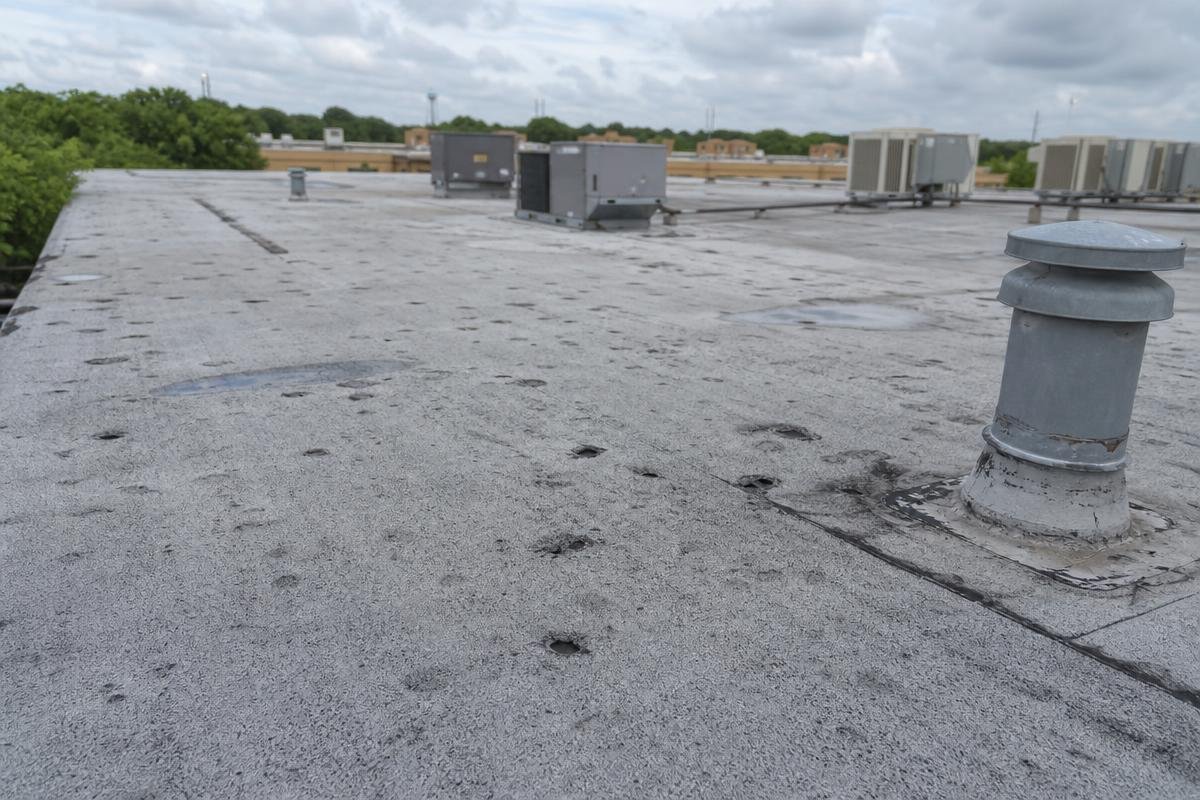
When water gets through a compromised commercial roof, it moves fast. If you are dealing with interior flooding after a storm, our flood cleanup team can respond around the clock.
Older Buildings, Older Roofs, Higher Stakes
A large share of the commercial building inventory along Office Park Circle, the I-35E corridor, and the retail strips flanking the SH-121 business park zone was built in the 1980s and 1990s. That means original roof membranes, flashing systems, and window seals that are 30 to 40 years old. Those systems were not designed to last indefinitely. They have been patched, re-coated, and pushed past their design life.
A hailstorm that a newer building absorbs without significant damage can trigger multiple simultaneous failures on one of these older properties. One storm, one event, and suddenly you are looking at a roof breach, interior water intrusion, and a claim scope that compounds fast. We work out of 824 Office Park Circle, right in the middle of this commercial district. We drive past these buildings every day. The risk here is real, and the age of your building matters more than most owners realize.
Frequently Asked Questions
How soon should I call a restoration contractor after a storm hits my commercial building?
Call the same day. The 48 to 72 hours after a hailstorm are when secondary water damage and mold remediation risk escalate fastest. A roof membrane breach that looks minor on Tuesday can soak insulation and ceiling tile by Thursday. We respond around the clock and can be on-site within 60 minutes for emergency situations across the Flower Mound, Carrollton, and Frisco corridors.
Does my commercial property insurance cover hail damage to the roof and HVAC units?
Most commercial property forms cover sudden and accidental hail and wind damage to the building structure, including roof membranes and HVAC units. Coverage depends on whether it’s written on a named-peril or open-peril basis, your deductible, and whether it pays actual cash value or replacement cost. Those two valuation methods produce very different claim checks. See our breakdown of what your commercial policy actually covers before you file.
How much does commercial storm damage restoration cost?
Small membrane repairs and HVAC fin straightening may run a few thousand dollars. Full roof replacement with interior water damage remediation on a large commercial building can reach six figures. We give you a written scope and cost estimate before any work begins. No surprises after the fact.
Can one contractor handle everything from tarping to interior repairs?
Yes. We handle emergency tarping, board-up, full roof repair, interior water damage mitigation, mold remediation, and pack-out and content cleaning. One point of contact from the first call through the final inspection. You will not be managing three different vendors while your tenants are waiting to reopen.
What happens to my tenants’ lost income if they can’t operate during repairs?
Your commercial property policy may include loss-of-rents coverage for displaced tenants. Your tenants’ own business interruption coverage handles their operational losses separately. Document displacement dates and keep all communication in writing from day one.
How long does commercial storm damage restoration take from start to finish?
Emergency stabilization happens within 24 to 48 hours. Structural repairs and roof replacement on a mid-size commercial building typically run one to three weeks. Interior remediation and finish work run concurrently where possible. We have been doing this since 2009, so we give you a realistic timeline at the initial assessment, not after work starts.
Your building may look fine from the parking lot. The roof membrane, the HVAC fins, the parapet flashing, and the insulation above your ceiling tiles tell a different story. Don’t let a quiet week after the storm cost you coverage. Once your carrier’s notice window closes, denied secondary damage is money you eat. Regent Restoration has been assessing and restoring commercial properties in this area since 2009. We respond around the clock. Call us at (214) 731-4624 to schedule your storm damage assessment while the timing still works in your favor. We will walk your property, document what we find, and give you a written scope before any work begins.
Ready to Get Started with Regent Restoration?
Call (214) 731-4624 to speak with our team directly. We’re ready to answer your questions, walk you through your options, and help you find the right solution for your needs. Whether you’re just starting to plan or ready to move forward, we’ll make the process simple and stress-free.
Reach out today and let’s talk about how we can help.